

As clinical trials become increasingly complex—spanning multiple geographies, therapeutic areas, regulatory frameworks, and decentralized models—the need for specialized digital systems has become non-negotiable.
Two foundational technologies supporting modern clinical research are:
- Clinical Data Management Systems (CDMS)
- Clinical Trial Management Systems (CTMS)
Although these systems are frequently discussed together and sometimes integrated within unified platforms, they serve distinct strategic purposes within the clinical trial lifecycle.
A clear understanding of the differences between CDMS and CTMS is essential for ensuring operational excellence, data integrity, regulatory compliance, and timely study execution.
What is CDMS?
A Clinical Data Management System (CDMS) is a technology platform designed to collect, validate, clean, and maintain clinical trial data in compliance with regulatory standards.
Its primary objective is to ensure that clinical data is accurate, consistent, traceable, and submission-ready.
Core Capabilities of CDMS:
- Electronic Case Report Form (eCRF) design and configuration
- Data entry and real-time validation
- Automated edit checks and discrepancy management
- Query generation and resolution tracking
- Audit trail maintenance
- Database lock and archival processes
- Compliance with regulatory requirements such as 21 CFR Part 11 and ICH-GCP
Primary Users:
- Clinical Data Managers
- Biostatisticians
- Clinical Research Associates (CRAs)
- Sponsor and CRO data teams
In essence, CDMS safeguards the scientific integrity of a clinical trial by ensuring high-quality, regulatory-compliant data.
What is CTMS?
A Clinical Trial Management System (CTMS) is an operational management platform used to plan, track, and manage the end-to-end execution of clinical trials.
Its primary focus is on study oversight, site management, milestone tracking, budgeting, monitoring activities, and performance analytics.
Core Capabilities of CTMS:
- Study planning and milestone management
- Site feasibility and activation tracking
- Subject enrollment oversight
- Monitoring visit scheduling and reporting
- Budget forecasting and payment tracking
- Investigator and site performance analytics
- Regulatory documentation tracking
- Resource and workload management
Primary Users:
- Clinical Project Managers
- Sponsor operations teams
- CRO management teams
- Site coordinators
- Finance and compliance teams
In summary, CTMS ensures that the clinical trial is executed efficiently, within budget, and in alignment with planned timelines.
What is the Difference Between CDMS and CTMS?
While both systems support clinical research, they address fundamentally different domains within the trial lifecycle
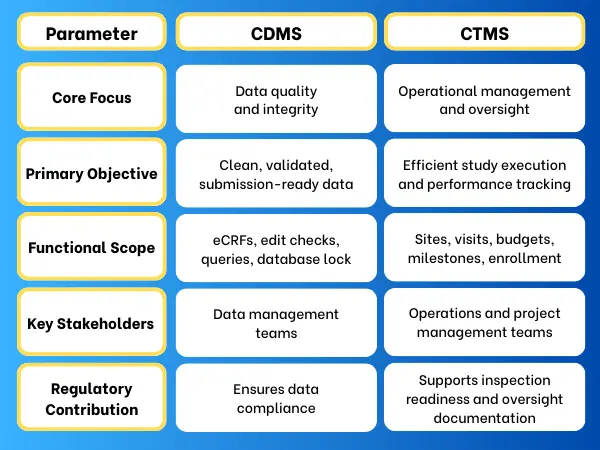
Knowing the Fundamental Distinctions Between CDMS and CTMS
Understanding the distinction becomes clearer when viewed through a lifecycle lens.
CDMS Concentrates On:
- Data capture and validation
- Ensuring statistical reliability
- Supporting regulatory submissions
- Maintaining audit trails and traceability
- Preparing datasets for analysis and reporting
CTMS Concentrates On:
- Study planning and execution
- Timeline adherence
- Budget monitoring and financial tracking
- Site performance management
- Monitoring visit coordination
- Resource allocation and oversight
Without a robust CDMS, the risk lies in compromised data integrity. Without an effective CTMS, the risk lies in operational inefficiencies, delays, and cost overruns. Modern clinical research demands strength in both domains.
How CDMS and CTMS Work Together
Although CDMS and CTMS serve distinct functional purposes, their true value is realized when they operate in a connected, interoperable ecosystem. Integration between operational oversight and data management creates a unified framework that enhances transparency, accelerates decision-making, and strengthens regulatory compliance.
Below are the key ways in which CDMS and CTMS collaborate to optimize clinical trial performance
1. Enrollment and Data Synchronization
CTMS tracks subject enrollment, screening, and retention across sites, while CDMS captures subject-level clinical data through eCRFs.
When integrated:
- Enrollment metrics in CTMS align with actual subject data in CDMS
- Discrepancies between screened and randomized subjects are minimized
- Real-time enrollment dashboards improve sponsor visibility
- Data reconciliation efforts are significantly reduced
This alignment ensures operational metrics reflect accurate clinical data.
2. Monitoring and Data Oversight
CTMS manages monitoring visit schedules, site performance metrics, and CRA activity tracking.
CDMS generates and manages data queries, discrepancies, and edit checks.
In an integrated environment:
- CRAs can assess site performance alongside data quality trends
- Monitoring priorities can be adjusted based on query volume or data inconsistencies
- Query resolution timelines can be tracked operationally
- Database lock processes are accelerated
This synergy enhances both monitoring efficiency and data integrity.
3. Financial and Performance Analytics
CTMS manages site payments, visit-based reimbursements, milestone payments, and budget tracking. CDMS provides insight into completed visits, subject status, and data completion rates.
When connected:
- Payments can be triggered based on verified data completion
- Budget forecasting aligns with actual patient progression
- Financial transparency improves across sites
- Overpayments or delays are minimized
This integration reduces manual reconciliation between finance and data teams, improving operational accuracy.
4. Risk-Based Monitoring and Data-Driven Decision Making
Modern trials increasingly rely on Risk-Based Monitoring (RBM) strategies. CTMS provides operational risk indicators such as enrollment delays, site deviations, or monitoring frequency gaps. CDMS contributes data-driven risk signals such as high query rates, protocol deviations, or inconsistent data patterns.
Together, they enable:
- Identification of high-risk sites through combined operational and data indicators
- Proactive corrective and preventive actions (CAPA)
- Improved resource allocation
- Enhanced compliance oversight
This integrated intelligence supports data-driven study governance.
5. Regulatory Compliance and Inspection Readiness
CTMS maintains documentation related to milestones, site communications, monitoring reports, and operational tracking. CDMS maintains complete audit trails, data change histories, and validation records.
When synchronized:
- Inspectors receive a comprehensive operational and data narrative
- Traceability between site activity and subject-level data is strengthened
- Documentation gaps are reduced
- Inspection preparation time decreases significantly
The result is improved inspection readiness and reduced regulatory risk.
The Convergence of CDMS and CTMS
The clinical research industry is increasingly shifting toward integrated clinical platforms that unify operational and data management capabilities.
The reason is straightforward:
Fragmented systems often result in:
- Duplicate data entry
- Manual reconciliation
- Limited cross-functional visibility
- Delayed reporting
- Increased compliance risks
Modern platforms now combine:
- CTMS
- CDMS
- eTMF
- ePRO
- Budget management
- Multi-site dashboards
This convergence enables:
- Real-time study intelligence
Centralized governance - Streamlined collaboration
- Faster decision-making
- Reduced operational costs
Sponsors and CROs are increasingly prioritizing unified ecosystems that eliminate silos and improve end-to-end trial oversight.
Summary: CDMS vs CTMS — Distinct Yet Interdependent
To conclude:
- CDMS ensures clinical data accuracy, traceability, and regulatory compliance.
- CTMS ensures structured, efficient, and controlled study execution.
- They serve different yet complementary roles within the clinical trial lifecycle.
- Maximum efficiency is achieved when both operate in an integrated ecosystem.
As trials become more global, data-intensive, and technology-driven, aligning operational oversight with data governance is no longer optional—it is essential.
Accelerate Smarter Trials with ImproWise
ImproWise platform brings CDMS and CTMS together within a unified, intelligent platform—delivering real-time visibility, streamlined workflows, and inspection readiness in one system.
If you are looking to reduce silos, improve compliance, and drive operational excellence, it’s time to experience how ImproWise can transform your clinical trial management strategy.
